The Planetary Boundaries — and Why 7 of 9 Are Now Breached
The Planetary Boundaries — and Why 7 of 9 Are Now Breached
The Planetary Boundaries — and Why 7 of 9 Are Now Breached
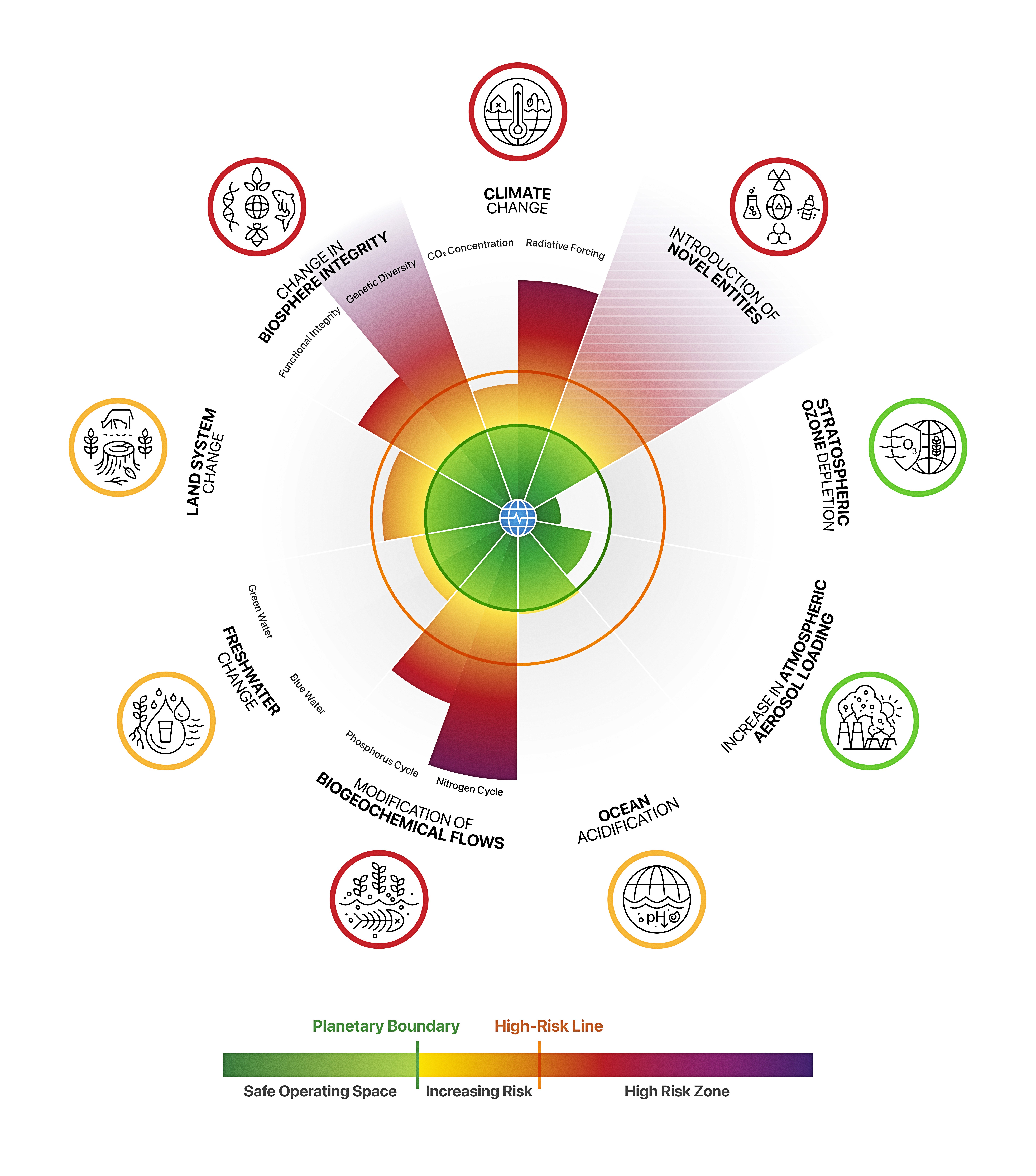
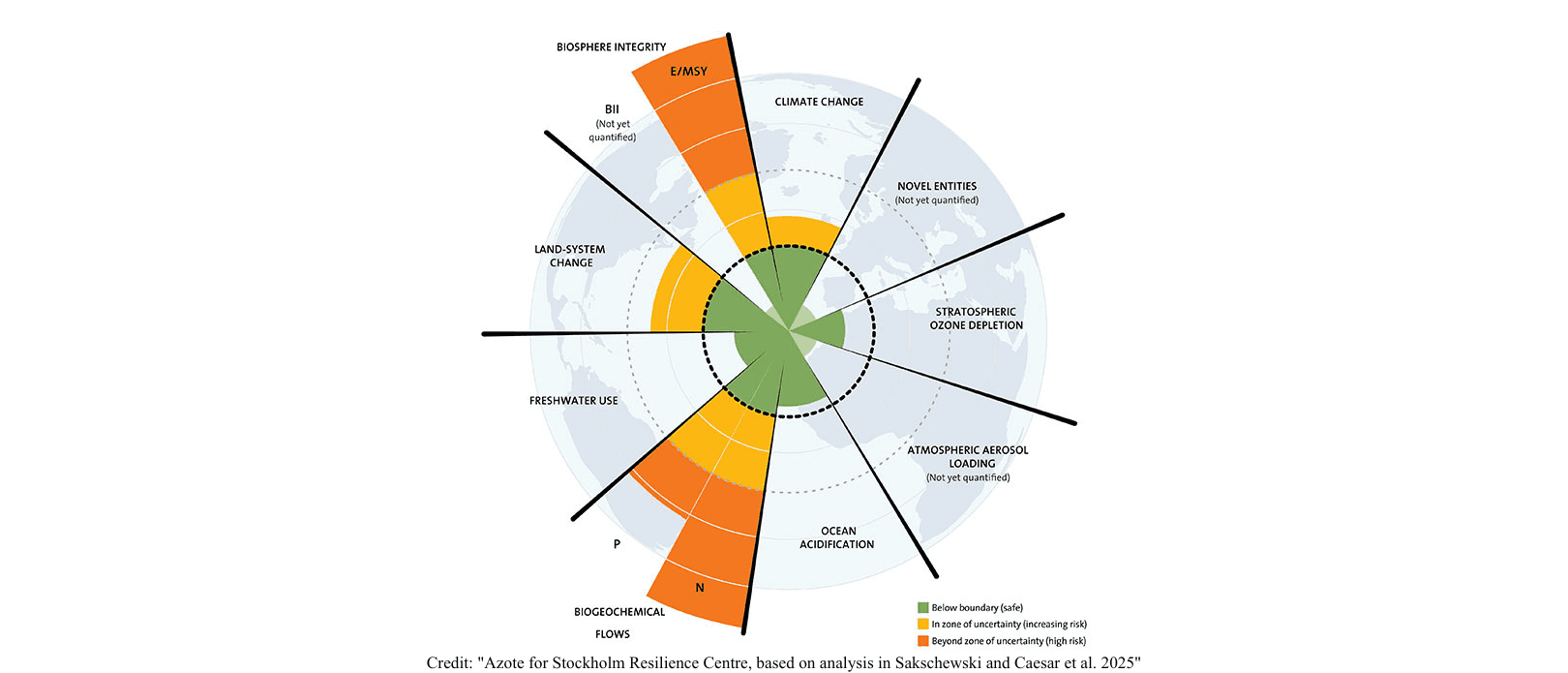
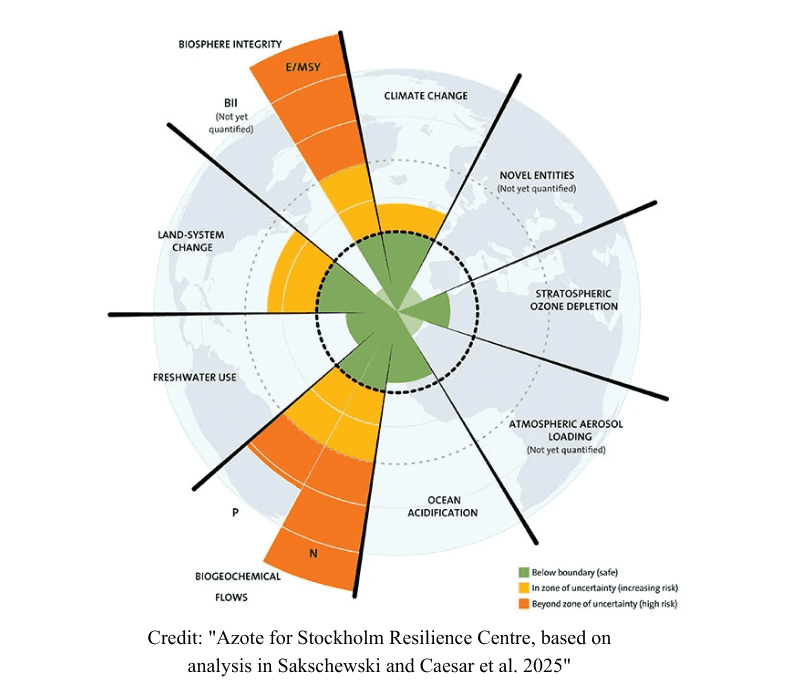
In 2009, an international team led by Johan Rockström introduced the planetary boundaries framework: nine Earth-system processes that together define a “safe operating space for humanity.” The aim was pragmatic, not abstract: if we stay within these limits, we preserve a climate and biosphere in which human societies have flourished. If we overshoot them, we increase the risks of abrupt, non-linear change. SRC maintains the canonical synthesis; PIK is a co-leader of the science program refining and communicating these thresholds. (https://www.pik-potsdam.de/en/output/infodesk/planetary-boundaries)
In 2009, an international team led by Johan Rockström introduced the planetary boundaries framework: nine Earth-system processes that together define a “safe operating space for humanity.” The aim was pragmatic, not abstract: if we stay within these limits, we preserve a climate and biosphere in which human societies have flourished. If we overshoot them, we increase the risks of abrupt, non-linear change. SRC maintains the canonical synthesis; PIK is a co-leader of the science program refining and communicating these thresholds. (https://www.pik-potsdam.de/en/output/infodesk/planetary-boundaries)
In 2009, an international team led by Johan Rockström introduced the planetary boundaries framework: nine Earth-system processes that together define a “safe operating space for humanity.” The aim was pragmatic, not abstract: if we stay within these limits, we preserve a climate and biosphere in which human societies have flourished. If we overshoot them, we increase the risks of abrupt, non-linear change. SRC maintains the canonical synthesis; PIK is a co-leader of the science program refining and communicating these thresholds. (https://www.pik-potsdam.de/en/output/infodesk/planetary-boundaries)
1. Climate Change — Breached
1. Climate Change — Breached
What it measures: Greenhouse-gas loading and resulting energy imbalance (warming), tracked via CO₂ concentrations, temperature, and Earth-system energy fluxes. Why it’s breached: Anthropogenic emissions from fossil fuels and land-use change have pushed warming well beyond the Holocene envelope, elevating risks of crossing tipping elements (ice sheets, rainforests, AMOC). Why it matters for capital: Physical risks (extremes, sea level), transition risks (policy/market shifts), and liability risks are now investment fundamentals. Action priorities: Rapid fossil-to-renewables shift, end new unabated fossil assets, electrify end-uses, expand storage and grids, deploy nature-based carbon sinks and high-integrity removals for hard-to-abate sectors. (See SRC/PIK boundary syntheses and WEF briefings.)
What it measures: Greenhouse-gas loading and resulting
Why it’s breached: Anthropogenic emissions from fossil fuels and land-use change have pushed warming well beyond the Holocene envelope, elevating risks of crossing tipping elements (ice sheets, rainforests, AMOC). Why it matters for capital: Physical risks (extremes, sea level), transition risks (policy/market shifts), and liability risks are now investment fundamentals. Action priorities: Rapid fossil-to-renewables shift, end new unabated fossil assets, electrify end-uses, expand storage and grids, deploy nature-based carbon sinks and high-integrity removals for hard-to-abate sectors. (See SRC/PIK boundary syntheses and WEF briefings.)
energy imbalance (warming), tracked via CO₂ concentrations, temperature, and Earth-system energy fluxes. Why it’s breached: Anthropogenic emissions from fossil fuels and land-use change have pushed warming well beyond the Holocene envelope, elevating risks of crossing tipping elements (ice sheets, rainforests, AMOC). Why it matters for capital: Physical risks (extremes, sea level), transition risks (policy/market shifts), and liability risks are now investment fundamentals. Action priorities: Rapid fossil-to-renewables shift, end new unabated fossil assets, electrify end-uses, expand storage and grids, deploy nature-based carbon sinks and high-integrity removals for hard-to-abate sectors. (See SRC/PIK boundary syntheses and WEF briefings.)
Links of Reference
Links of Reference
https://www.stockholmresilience.org/research/planetary-boundaries.html
https://www.weforum.org/stories/2024/10/planetary-boundaries-breached-nature-climate-stories/
https://www.weforum.org/stories/2024/10/planetary-boundaries-breached-nature-climate-stories/
https://www.weforum.org/stories/2024/06/risks-earth-systems-are-rising-businesses-are-taking-action/
2. Biosphere Integrity (Biodiversity) — Breached
2. Biosphere Integrity (Biodiversity) — Breached
What it measures: The state of life on Earth — genetic diversity and functional ecosystem integrity. Why it’s breached: Habitat conversion, overexploitation, pollution, invasive species, and climate impacts reduce ecosystem function and resilience. Why it matters for capital: Collapsing ecosystem services (pollination, water regulation, fisheries) are material to agriculture, pharmaceuticals, insurance, and national security. Action priorities: Protect and restore ecosystems at scale; deforestation-free supply chains; regenerative agriculture; circular chemistry to cut pollutants; outcomes-based biodiversity credits tied to real gains, not paper claims. (SRC/PIK analyses.)
What it measures: The state of life on Earth — genetic diversity and functional ecosystem integrity. Why it’s breached: Habitat conversion, overexploitation, pollution, invasive species, and climate impacts reduce ecosystem function and resilience. Why it matters for capital: Collapsing ecosystem services (pollination, water regulation, fisheries) are material to agriculture, pharmaceuticals, insurance, and national security. Action priorities: Protect and restore ecosystems at scale; deforestation-free supply chains; regenerative agriculture; circular chemistry to cut pollutants; outcomes-based biodiversity credits tied to real gains, not paper claims. (SRC/PIK analyses.)
3. Land-System Change — Breached
3. Land-System Change — Breached
What it measures: Conversion of forests, grasslands, and wetlands, typically benchmarked against intact forest cover and landscape functionality. Why it’s breached: Agricultural expansion, urban sprawl, and extractive activities fragment habitats, reduce carbon sinks, and alter regional climates. Why it matters for capital: Land degradation undermines yields, hydrology, and carbon markets, while exposing portfolios to policy and reputational risk. Action priorities: Zero-deforestation commodity systems; restoration finance; precision/indoor ag where appropriate; agroforestry; enforceable land-use governance and traceability. (SRC 2023 update; WEF primers.)
What it measures: Conversion of forests, grasslands, and wetlands, typically benchmarked against intact forest cover and landscape functionality. Why it’s breached: Agricultural expansion, urban sprawl, and extractive activities fragment habitats, reduce carbon sinks, and alter regional climates. Why it matters for capital: Land degradation undermines yields, hydrology, and carbon markets, while exposing portfolios to policy and reputational risk. Action priorities: Zero-deforestation commodity systems; restoration finance; precision/indoor ag where appropriate; agroforestry; enforceable land-use governance and traceability. (SRC 2023 update; WEF primers.)
4. Biogeochemical Flows (Nitrogen & Phosphorus) — Breached
4. Biogeochemical Flows (Nitrogen & Phosphorus) — Breached
What it measures: Human perturbation of N and P cycles via fertilisers and waste streams driving eutrophication and dead zones. Why it’s breached: Excess nutrient application, poor manure management, and untreated wastewater. Why it matters for capital: Fishery collapse, water treatment costs, and regulatory tightening affect food, chemicals, and municipal infrastructure. Action priorities: Precision nutrient management; green ammonia (low-carbon Haber-Bosch); nitrification inhibitors; circular nutrient recovery from wastewater; wetland buffers. (SRC/PIK boundary synthesis.)
Why it’s breached: Anthropogenic emissions from fossil fuels and land-use change have pushed warming well beyond the Holocene envelope, elevating risks of crossing tipping elements (ice sheets, rainforests, AMOC). Why it matters for capital: Physical risks (extremes, sea level), transition risks (policy/market shifts), and liability risks are now investment fundamentals. Action priorities: Rapid fossil-to-renewables shift, end new unabated fossil assets, electrify end-uses, expand storage and grids, deploy nature-based carbon sinks and high-integrity removals for hard-to-abate sectors. (See SRC/PIK boundary syntheses and WEF briefings.)
What it measures: Greenhouse-gas loading and resulting energy imbalance (warming), tracked via CO₂ concentrations, temperature, and Earth-system energy fluxes. Why it’s breached: Anthropogenic emissions from fossil fuels and land-use change have pushed warming well beyond the Holocene envelope, elevating risks of crossing tipping elements (ice sheets, rainforests, AMOC). Why it matters for capital: Physical risks (extremes, sea level), transition risks (policy/market shifts), and liability risks are now investment fundamentals. Action priorities: Rapid fossil-to-renewables shift, end new unabated fossil assets, electrify end-uses, expand storage and grids, deploy nature-based carbon sinks and high-integrity removals for hard-to-abate sectors. (See SRC/PIK boundary syntheses and WEF briefings.)
What it measures: Greenhouse-gas loading and resulting energy imbalance (warming), tracked via CO₂ concentrations, temperature, and Earth-system energy fluxes. Why it’s breached: Anthropogenic emissions from fossil fuels and land-use change have pushed warming well beyond the Holocene envelope, elevating risks of crossing tipping elements (ice sheets, rainforests, AMOC). Why it matters for capital: Physical risks (extremes, sea level), transition risks (policy/market shifts), and liability risks are now investment fundamentals. Action priorities: Rapid fossil-to-renewables shift, end new unabated fossil assets, electrify end-uses, expand storage and grids, deploy nature-based carbon sinks and high-integrity removals for hard-to-abate sectors. (See SRC/PIK boundary syntheses and WEF briefings.)
5. Freshwater Change — Breached
5. Freshwater Change — Breached
What it measures: Alterations in blue water (rivers/lakes) and green water (soil moisture) regimes. Why it’s breached: Over-abstraction, river regulation, groundwater depletion, climate-driven aridification, and land-system change reduce resilience. Why it matters for capital: Water scarcity is an enterprise-level constraint across energy, semiconductors, food, and textiles; sovereign and community stability also hinge on it. Action priorities: Basin-level allocation; water-efficient crops and desalination where sensible; leak reduction; demand-side digital water; watershed restoration; pricing that reflects scarcity. (SRC’s 2023 boundary assessment; WEF coverage.)
What it measures: Alterations in blue water (rivers/lakes) and green water (soil moisture) regimes. Why it’s breached: Over-abstraction, river regulation, groundwater depletion, climate-driven aridification, and land-system change reduce resilience. Why it matters for capital: Water scarcity is an enterprise-level constraint across energy, semiconductors, food, and textiles; sovereign and community stability also hinge on it. Action priorities: Basin-level allocation; water-efficient crops and desalination where sensible; leak reduction; demand-side digital water; watershed restoration; pricing that reflects scarcity. (SRC’s 2023 boundary assessment; WEF coverage.)
6. Novel Entities (Synthetic Chemicals & Plastics) — Breached
6. Novel Entities (Synthetic Chemicals & Plastics) — Breached
What it measures: New substances (e.g., PFAS, plastics), and modified organisms that can disrupt Earth-system functions when production and release exceed monitoring and management capacity. Why it’s breached: Exponential growth of chemical production without full life-cycle controls; microplastics now pervasive in oceans, soils, and air. Why it matters for capital: Regulatory bans, litigation, remediation liabilities, and consumer shifts. Action priorities: Safe-and-sustainable-by-design chemistry; rapid phase-down of persistent toxics; closed-loop plastics; extended producer responsibility; advanced sorting and depolymerisation. (SRC/PIK frameworks; WEF business risk overviews.)
What it measures: New substances (e.g., PFAS, plastics), and modified organisms that can disrupt Earth-system functions when production and release exceed monitoring and management capacity. Why it’s breached: Exponential growth of chemical production without full life-cycle controls; microplastics now pervasive in oceans, soils, and air. Why it matters for capital: Regulatory bans, litigation, remediation liabilities, and consumer shifts. Action priorities: Safe-and-sustainable-by-design chemistry; rapid phase-down of persistent toxics; closed-loop plastics; extended producer responsibility; advanced sorting and depolymerisation. (SRC/PIK frameworks; WEF business risk overviews.)
7. Ocean Acidification — Breached (2025)
7. Ocean Acidification — Breached (2025)
What it measures: The ocean’s carbonate chemistry (pH and aragonite saturation) that underpins marine life and carbon buffering. Why it’s breached: CO₂ uptake from fossil emissions has lowered surface-ocean pH ~0.1 units since pre-industrial times (a ~30–40% rise in acidity), degrading coral reefs and shell-forming organisms and weakening the ocean carbon sink. Why it matters for capital: Fisheries, coastal protection, and blue-economy assets face compounding risks with warming, deoxygenation, microplastics, and nutrient overloads. Action priorities: Accelerate fossil phase-out; protect/restore coastal blue carbon ecosystems; curb nutrient and plastic pollution; invest in monitoring and science-based aquaculture adaptation. Rockström summarises the stakes — and the recoverability of ocean systems once pressures are lifted. (SRC/PIK 2025 updates; interviews and reporting.)
“The ocean and the life it harbors can bounce back once the stresses are alleviated… The best way to do that is to stop burning fossil fuels.” — Johan Rockström (interviewed at the time of the 2025 assessment).
What it measures: The ocean’s carbonate chemistry (pH and aragonite saturation) that underpins marine life and carbon buffering. Why it’s breached: CO₂ uptake from fossil emissions has lowered surface-ocean pH ~0.1 units since pre-industrial times (a ~30–40% rise in acidity), degrading coral reefs and shell-forming organisms and weakening the ocean carbon sink. Why it matters for capital: Fisheries, coastal protection, and blue-economy assets face compounding risks with warming, deoxygenation, microplastics, and nutrient overloads. Action priorities: Accelerate fossil phase-out; protect/restore coastal blue carbon ecosystems; curb nutrient and plastic pollution; invest in monitoring and science-based aquaculture adaptation. Rockström summarises the stakes — and the recoverability of ocean systems once pressures are lifted. (SRC/PIK 2025 updates; interviews and reporting.)
“The ocean and the life it harbors can bounce back once the stresses are alleviated… The best way to do that is to stop burning fossil fuels.” — Johan Rockström (interviewed at the time of the 2025 assessment).
The Two Boundaries Not (Yet) Globally Breached
The Two Boundaries Not (Yet) Globally Breached
• Atmospheric Aerosol Loading: Regionally critical (e.g., South Asia) but not yet a global transgression; aerosols interact with monsoons, health, and climate forcing. (WEF/SRC explainer.)
• Stratospheric Ozone: A rare success story — thanks to the Montreal Protocol, the ozone layer is on a recovery path, illustrating that coordinated global policy and market shifts can work. (SRC/WEF.)
• Atmospheric Aerosol Loading: Regionally critical (e.g., South Asia) but not yet a global transgression; aerosols interact with monsoons, health, and climate forcing. (WEF/SRC explainer.)
• Stratospheric Ozone: A rare success story — thanks to the Montreal Protocol, the ozone layer is on a recovery path, illustrating that coordinated global policy and market shifts can work. (SRC/WEF.)